ARKE Audio
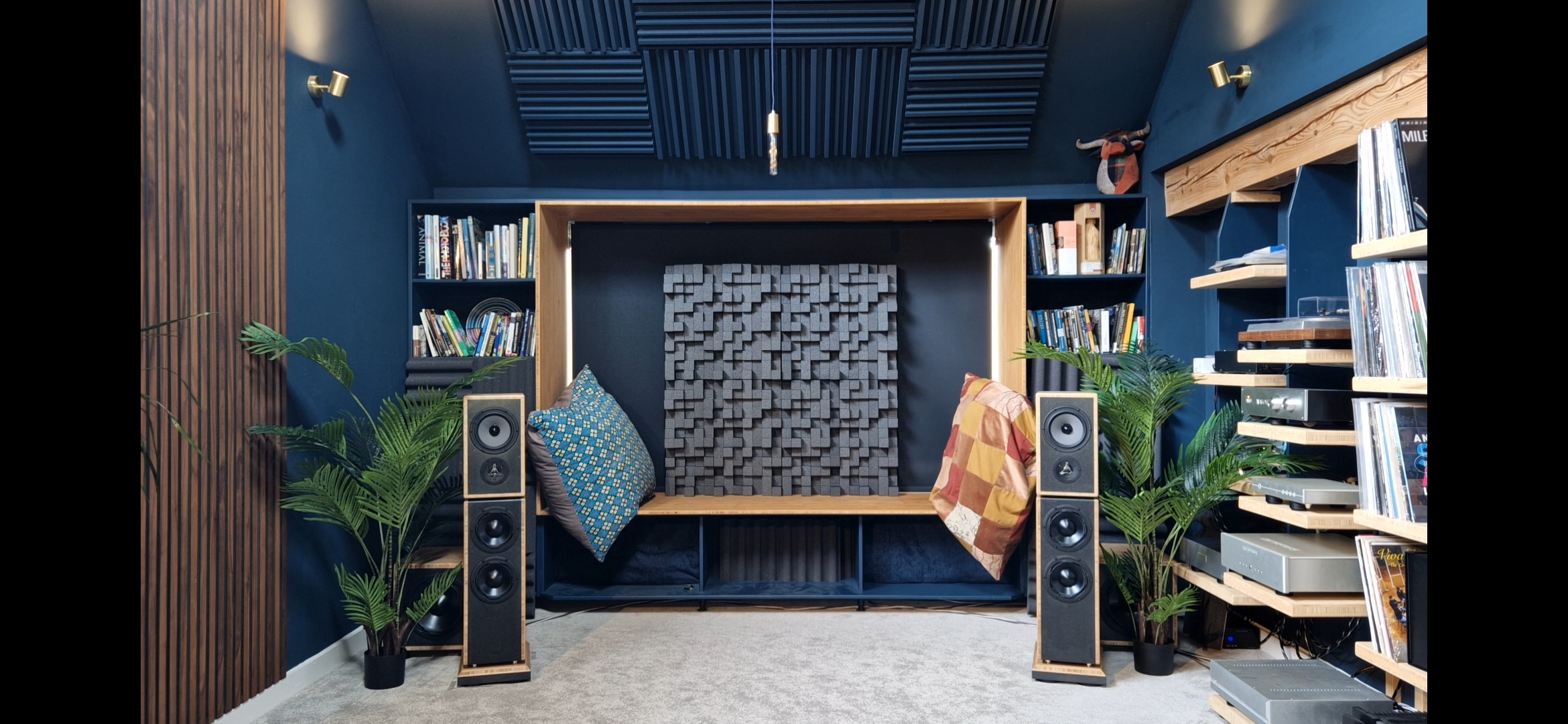
As some know, we have built a dedicated listening room, AKA the Music room.

It started life as a family and music room, but now I also use it for testing and demos of my speakers. I did begin with a "no obvious treatments" rule, but that has changed recently as my room is now for demos also.

The room already has large bass traps (hidden in bookshelves), acoustic slat wall and a concrete floor with a thick underlay and carpet. There are also bookshelves, vinyl shelves and canvases with rockwool inside. In addition, there there are around 5 large plants, heavy, lined curtains and double blinds.

I wondered what more in possible so got some diffusers to experiment...
 
This is roughly how the room is (a few weeks ago now):
 
 
There is a large picture window on the front wall behind the speakers. This isn't ideal for acoustics, but the view is nice 👌. The alcove/shelves around the picture window have rockwool at the rear and range from 200-400mm thick. The thicker rockwool is lower down and in the corners. The shelves have books and stuff on them for diffusion.

There is slat wall at the first reflection of the Left speaker and a large bank or shelves at the first reflection of the right speaker.

There are 2 large plants outboard of both speakers.
The stuff on the window sill is temporary and me experimenting - more on this soon.
 
 
This is around the listening area. There are two large bass traps in each corner, with acoustic slat wall on their front faces. There are heavy, lined curtains behind the listening area. There are various plants and canvases (with Rockwool inside) around the listening area.
 
I'll add most posts soon as I add treatments and experiment with lots of options
Beautifully engineered sound
 
Introductory offers available - please see website for details.
 
Please follow us on Instagram and Facebook
Approved dealer for Stack Audio products.
Reply 7 0
ARKE Audio
I have added a fair bit of absorption and diffusion to my room. It is a relatively large room, so even with all the additional panels I have probably only covered 15-20% of the walls and ceiling. This is not a lot really, and includes bookshelves, slat wall, canvasses and curtains etc. (the normal domestic stuff)

I have now added some EPS WDS-7 (QRD) diffusers to the sloping ceilings above the listening area and above the front wall.  


This is above the listening area:
 
 
There are also various panels on the window sill of the front wall. Having a window here (even with blinds) has proved problematic for a truly wide and deep soundstage. Also, the reflections of the front wall (the window/blind) were effectively smearing the image and reducing coherence - it is all relative, of course. However, with the additional panels on the sill it sounded many times better - adding £200 of treatments has given a much greater SQ leap than a large component upgrade! I was amazed at what difference it makes - I knew the theory, but in honesty thought the difference would be tiny. I was very wrong - I can now get an insight into what the speakers are really doing. The layering and nuance is now breath-taking and instruments sound way more realistic - I thought they were good before, but I was wrong. The panels are removeable as I shall use them at shows and in the summer I like the view! Most of my winter listening is when it's dark, so the panels can be on the sill.

This is me painting the panels (it was an extremely boring job!):
 
 
I realise this is massively OTT for most people, but part of my job is helping clients to add room acoustics and helping them to understand what they do and why they may like them.

I have also spent a few days testing and listening to diffusers and absorbers on the front wall (centrally and behind the speakers). The ratios and arrangements of diffusers/absorbers makes a BIG difference to the presentation and coherence - it was surprising how much. I'll put that in the next post.
Beautifully engineered sound
 
Introductory offers available - please see website for details.
 
Please follow us on Instagram and Facebook
Approved dealer for Stack Audio products.
Reply 7 0
Hear Here
More dogs will fix things!
 
20251129 160520
Source - NAD M50.2 - CD Player, CD Ripper, Hard Drive file store, Streamer
Amplification - NAD M66 - Streamer, DAC, Preamp, Atma-Sphere Class D mono power amps
Speakers - Avantgarde Duo XD with modified supports
In Storage - NAD M12 Preamp, NAD M33 All-in-one
Reply 2 0
DeeFran
Thanks for posting this, have given me some ideas.
 
Especially about plants, think you posted elsewhere how they can help.
 
Cheers Frank
" One good thing about music, when it hits you, you feel no pain."
Reply 1 0
HIGHWAY61
I suspect there is an "X" marked on the floor, out of sight on the photo. He/she has to sit there as that exact position is the last piece in finding that Nirvana sound. Plants, beanbags, cushions, rugs and curtains all help for those with the fortitude to go down this path.
Reply 0 0
ARKE Audio
I suspect there is an "X" marked on the floor, out of sight on the photo. He/she has to sit there as that exact position is the last piece in finding that Nirvana sound. Plants, beanbags, cushions, rugs and curtains all help for those with the fortitude to go down this path.
Almost the opposite.... adding the latest room treatments has actually made the sweetspot much larger.  It has become less important to sit with your head in vice!
 
Agreed, all the furnishings are plants are great and usually enough.  However, i specialise in setup and room/speaker interaction, so an appreciation of different approaches is very beneficial.  
Beautifully engineered sound
 
Introductory offers available - please see website for details.
 
Please follow us on Instagram and Facebook
Approved dealer for Stack Audio products.
Reply 4 0
Jules_S
This is fascinating reading, and very relevant for me as I'm about to start planning my new music room layout and fit-out. I'm in a rented property so there are some limits to what I can do, but certainly freestanding and wall / ceiling-mounted treatment will be possible. (plus lots of plants of course!)
 
Question on the slatted wooden panels - are those the type that you can find in most DIY shops or are they specific audio-grade ones? I'm not sure what the backing of them is. I think the DIY ones don't have a lot of "padding" behind so not sure what part of the audio band they might help with absorption or how much. I assume it's the mid & upper frequencies - 5KHz-ish and upwards? Is it more about the diffusion properties than absorption? I do like the look of them and feel they might possibly have a purpose in my room.
 
I'm going to start a new thread anyway so don't want to hijack this one but I shall be watching for your updates 👍🏼
Are we there yet?
Reply 3 0
ARKE Audio
This is fascinating reading, and very relevant for me as I'm about to start planning my new music room layout and fit-out. I'm in a rented property so there are some limits to what I can do, but certainly freestanding and wall / ceiling-mounted treatment will be possible. (plus lots of plants of course!)
 
Question on the slatted wooden panels - are those the type that you can find in most DIY shops or are they specific audio-grade ones? I'm not sure what the backing of them is. I think the DIY ones don't have a lot of "padding" behind so not sure what part of the audio band they might help with absorption or how much. I assume it's the mid & upper frequencies - 5KHz-ish and upwards? Is it more about the diffusion properties than absorption? I do like the look of them and feel they might possibly have a purpose in my room.
 
I'm going to start a new thread anyway so don't want to hijack this one but I shall be watching for your updates 👍🏼
Please post on here, it is not really supposed be just about my room.  Be great to discuss options and people's experience.   I'll answer your questions shortly.
Beautifully engineered sound
 
Introductory offers available - please see website for details.
 
Please follow us on Instagram and Facebook
Approved dealer for Stack Audio products.
Reply 1 0
Jules_S
Please post on here, it is not really supposed be just about my room.  Be great to discuss options and people's experience.   I'll answer your questions shortly.
Thanks - for anything treatment-related I'll ask here, but I'll keep the general room stuff to a separate thread so as not to confuse things. I'm not quite at the stage of being ready yet for this, need to work out my basic layout and acoustic properties first. Walk before I run!
Are we there yet?
Reply 1 0
ARKE Audio
This is fascinating reading, and very relevant for me as I'm about to start planning my new music room layout and fit-out. I'm in a rented property so there are some limits to what I can do, but certainly freestanding and wall / ceiling-mounted treatment will be possible. (plus lots of plants of course!)
 
Question on the slatted wooden panels - are those the type that you can find in most DIY shops or are they specific audio-grade ones? I'm not sure what the backing of them is. I think the DIY ones don't have a lot of "padding" behind so not sure what part of the audio band they might help with absorption or how much. I assume it's the mid & upper frequencies - 5KHz-ish and upwards? Is it more about the diffusion properties than absorption? I do like the look of them and feel they might possibly have a purpose in my room.
 
I'm going to start a new thread anyway so don't want to hijack this one but I shall be watching for your updates 👍🏼
Partly because they looked better quality and the veneers were decent.  They have a 10mm acoustic felt, so will absorb High frequencies - they are a good low-ish cost and attractive option.  They really help to suppress echo. The diffuse to a degree, however, because the slat size and spacing is consistent they will only diffuse a very narrow bandwidth.  The 'proper' diffusers are mathematically designed and based around fractions of prime numbers, therefore they diffuse relatively evenly over a much wider bandwidth.  The 'proper' diffusers do look obviously like room treatments, but I personally like the look, especially some of the nice wooden ones - although they can be pricey.
 
Every room is different and some people will care about the difference treatments make and others will not. IMO is the best and most profound difference I have ever made to my system! Ironically, my system hasn't changed - just the room.
 
Buying some lightweight and cheaper stuff to experiment is the best way too start.  I used 6-9mm ply to make some 600x1200mm panels.  Some are basic ridged foam (absorption) and some are EPS diffusers (which can be painted).  They make lightweight and effective panels, which can be great to move around and experiment with. Slat wall is relatively light and can be used for test panels too.
 
I have also made slatwall panels with 50mm of rockwool behind (this will absorb slightly lower frequencies).
 
To start, focus on potential layouts and then look into bass traps and first reflections.  Controlling the bass and first reflections are most important.
Beautifully engineered sound
 
Introductory offers available - please see website for details.
 
Please follow us on Instagram and Facebook
Approved dealer for Stack Audio products.
Reply 4 0
ARKE Audio
This is fascinating reading, and very relevant for me as I'm about to start planning my new music room layout and fit-out. I'm in a rented property so there are some limits to what I can do, but certainly freestanding and wall / ceiling-mounted treatment will be possible. (plus lots of plants of course!)
 
Question on the slatted wooden panels - are those the type that you can find in most DIY shops or are they specific audio-grade ones? I'm not sure what the backing of them is. I think the DIY ones don't have a lot of "padding" behind so not sure what part of the audio band they might help with absorption or how much. I assume it's the mid & upper frequencies - 5KHz-ish and upwards? Is it more about the diffusion properties than absorption? I do like the look of them and feel they might possibly have a purpose in my room.
 
I'm going to start a new thread anyway so don't want to hijack this one but I shall be watching for your updates 👍🏼
my slatwall is from here: https://www.armstrongnaturalwalling.co.uk/wooden-slats Partly because they looked better quality and the veneers were decent.  They have a 10mm acoustic felt, so will absorb High frequencies - they are a good low-ish cost and attractive option.  They really help to suppress echo. The diffuse to a degree, however, because the slat size and spacing is consistent they will only diffuse a very narrow bandwidth.  The 'proper' diffusers are mathematically designed and based around fractions of prime numbers, therefore they diffuse relatively evenly over a much wider bandwidth.  The 'proper' diffusers do look obviously like room treatments, but I personally like the look, especially some of the nice wooden ones - although they can be pricey.
 
Every room is different and some people will care about the difference treatments make and others will not. IMO is the best and most profound difference I have ever made to my system! Ironically, my system hasn't changed - just the room.
 
Buying some lightweight and cheaper stuff to experiment is the best way too start.  I used 6-9mm ply to make some 600x1200mm panels.  Some are basic ridged foam (absorption) and some are EPS diffusers (which can be painted).  They make lightweight and effective panels, which can be great to move around and experiment with. Slat wall is relatively light and can be used for test panels too.
 
I have also made slatwall panels with 50mm of rockwool behind (this will absorb slightly lower frequencies).
 
To start, focus on potential layouts and then look into bass traps and first reflections.  Controlling the bass and first reflections are most important.
Beautifully engineered sound
 
Introductory offers available - please see website for details.
 
Please follow us on Instagram and Facebook
Approved dealer for Stack Audio products.
Reply 0 0
ARKE Audio
Long post warning! Strap in with a brew or a beer if you want to read about my front wall treatment testing....
 
Here is a rundown of what difference the various diffusers and absorption made on my front wall - this is obviously very room and system specific, however, I think some of what I discovered will be useful to set up other rooms (especially at shows) more effectively.

Some background information:
  • The front of the speakers are about 1.5-1.6m off the front wall and window;
  • The window and reveal has a blind (relatively reflective) as standard;
  • Shelving alcoves flanking the window reveal and contain 300-400mm of rockwool in the lower 3 sections (behind the speakers) and the upper 2 alcoves have 150-200mm of rockwool and books (for diffusion) in front;
  • The 8 x WDS-7 (QRD) panels were in place on the sloping ceiling (above) for all tests.
  • The plants remained next the speakers.
  • The first reflections (on side walls) are covered by slat wall on the left and shelving on the R.  It isn't symmetrical, but that wasn't really practical.
The panels I used were:
1 x 600 x 1200mm acoustic slat wall (walnut slats) panel with 50mm rockwool behind - limited diffusion and mostly absorption.
2 x 600 x 1200mm ridged foam absorber panels (70mm at deepest point) - mostly absorption
1 x 300 x 1200mm ridged foam absorber panels (70mm at deepest point) - mostly absorption
2 x 600 x 1200mm Manhattan Skyline EPS 150mm deep on highest blocks - 2D diffusion
2 x 600 x 600 WDS-7 (QRD) diffusers - 1D diffusion.

I have been trying different configs for about a week over about 16-20hrs of listening, it was surprising what some even tiny changes could make. This is a summary of the main options I tried:

1) Standard config - no treatment on window sill, except two large cushions. No diffusers or absorbers present except for the bass traps, books and WDS-7 on the sloping ceiling.

(no picture)

This was what most people have experienced in this room, but without the ceiling diffusers.  It doesn't sound bad at all, but listening in @optical 's room highlighted that there were issues.  I can understand the issues more in hindsight (having heard the latest treatments in place).  

In summary: a relative lack of coherence.  The soundstage is large and gives the 'impression' of depth, but in reality the instruments and vocals lack the true 3D quality and focus. After hearing with the panels, it is obvious that there is smearing and softening of the leading edges with nothing in place.  The decay of notes is more difficult to follow.  Tiny micro-details and nuance are mostly smothered, even though they are there somewhere.

2) 2 x Skylines in the centre of the sill - Ridged foam absorbers behind the speakers.
[Screenshot-20251220-103749-Gallery]

Now we're talking!  This wasn't the best, but a very big improvement over nothing on the sills. Wow, suddenly a coherence and focus I have never heard in my room - it was showing a level of transparency and nuance I didn't realise the system had. The soundstage now had 3D depth and it was much easier to follow the music, especially in complex mixes - even tiny details in loud passages were easy to follow and not lost. Dynamics, especially in the centre stage, improved dramatically - leading edges were much crisper and drums, guitar plucks and piano key strikes were much more percussive.  It was great to hear such dynamics and coherence.  It was easy to hear that a veil (all relative) of colouration had lifted too - instruments just sounded more natural and had a greater level of vitality.  It certainly hadn't become bright of edgy though, it was like a level of haze and hash had been removed. It actually became easier to get absorbed and completely lost in the music - almost like the brain is no longer having to filter out some of the (out of phase) reflections and timing issues.  It was like a decent band becoming and incredible tight and coherent band - everything just clicks into place more and the music is just easier to follow and enjoy.

Now the 'but'.  However, by comparison to some other configs there was a still a lack of coherence in the areas around the central image.  There was still some exposed blind to the left and right of the skylines and it was still obvious that these regions were affecting the soundstaging and imaging in those areas.  It's hard to describe, but it is like staring an a picture - some is in stunning and beautiful focus and some is still a little blurred and muddled.  The central area was great, around the speakers was good, but there were two vertical bands (between the skylines and speakers) were the image was less coherent.

3) 2 x Skylines on the outer edges of the sill and just blinds in the centre.

[Screenshot-20251220-103816-Gallery]

Almost the opposite the last config.  The area between the centre stage and the speakers had now come into focus - instruments just inboard of the speakers were now much better - more 3D and more focussed.  However, (you guessed it) the centre stage had now lost that focus, clarity, dynamics and 3D quality.  Vocals were now soft and not as vivid.

Bear in mind that this is all relative... all configs were better than nothing, however, improving part of the picture had the effect of making the untreated areas more obvious.

3) 2 x Skylines on the outer edges of the sill and the slatted absorber in the centre.

[Screenshot-20251220-103739-Gallery]

An improvement on the last option.  The centre stage had now improved, but wasn't as focussed and coherent as the centre stage with the skylines in the centre.

4) 2 x Skylines on the outer edges of the sill and 2 vertical WDS-7 in the centre of the sill.

[Screenshot-20251220-103710-Gallery]

Things are starting to get very good now!  We now have coherence, focus, 3D imaging and wonderful dynamics and tonality across the soundstage from speaker to speaker. With the WDS-7 running vertically the sound is diffused horizontally (1D) so this gives the subtle impression the vocals/instruments being slightly fuller in width.

5) 2 x Skylines on the outer edges of the sill and 2 horizontal WDS-7 in the centre of the sill.

[Screenshot-20251220-102548-Gallery]

Very, very good again.  I hadn't expected the WDS-7 diffusion to be so versatile - I certainly hadn't expected to be able to hear the difference of orientation. With the WDS-7 now running horizontally the sound was being diffused vertically - only subtle, but it was clear to hear.  The vocals and centre stage instruments became a bit taller, however, the outer edges of the soundstage remained at a more 'normal' (for my room) height - this created a very slight variation in height of the soundstage across it's width. This wasn't necessarily a bad thing - we are talking about very fine tuning here - it more comes down to personal preference when digging this deep.

6) 2 x Skylines on the outer edges of the sill & 1 x horizontal WDS-7 & 1 x vertical WDS-7 in the centre of the sill.

[Screenshot-20251220-103653-Gallery]

[Screenshot-20251220-103722-Gallery]

This was the best so far. There are two options here and it was hard to choose between them.  They both provided a good compromise between options 4 and 5.  It seems that alternating them helps to provide that balance. Perhaps a proper 2D diffuser would be better, but I liked that I could tweak by changing their orientation - this could be useful at shows.

7) Now the wildcard! 2 x ridged absorbers on the outer edges of the sill & 1 x horizontal WDS-7 & 1 x vertical WDS-7 in the centre of the sill. PLUS: the skylines are now behind the speakers and pushed snugly up to the alcove bass traps.

[Screenshot-20251220-103621-Gallery]

[20251216-131928]

[20251216-131919]

This was unexpected, and I stumbled across this by mistake.  I had fully expected to have the skylines on the sill, however, I did this out of curiosity and REALLY like it. It had a few unexpected advantages.  Having the ridged foam absorbers flanking the WDS-7 seemed to work really well - the foam absorption was minimising the reflections off the blinds and the WDS-7s were giving a lovely focus and clarity to the centre image.  The central diffusion (flanked by foam) was having the effect of shining a light on the vocals and centre stage - it is curating the presentation a little, but it works really well (IMO) in my room.

Now, the biggest surprise... Putting the skylines behind the speakers was doing 3 things I really liked:
1) the speakers were really disappearing into the outer edges of the soundstage and everything panned left and right had more coherence, clarity and micro-detail;
2) the soundstage was now higher, deeper and wider on the outer edges - it matched the centre stage better.  The biggest gain was the soundstage width - it seemed much wider and the outer limits didn't seem defined by my room anymore.
3) the BASS! I hadn't expected this all... diffusion was improving the bass, but how? Cleaning up the leading edges and clarity in the mids and HF does have the effect of improving bass definition, however, I believe that wasn't the main contributor. I realised that the skylines (on 9mm ply) were virtually completely blocking the alcove bass traps behind the speakers.  The 3 alcoves only had tiny entry and exit gaps.  Some bass trap use membranes to restrict the airflow in and out and create pressure - this allows them to affect deeper frequencies and to target narrower bandwidths more effectively. I haven't measured the effect, but I assume the skylines were doing this to a degree.  The bass was now tighter, more textured and had more solidity. It was more percussive and generally just better - it made me smile!

Currently, I am using option 7.  It makes a profound difference and all music I know really well has taken on a whole new dimension.  The whole presentation has changed and just become more effortless and musical.  Coherence, focus and clarity have increased a lot, but not in an edgy or bright way - everything is more natural, dynamic and just have more poise and nuance.  Micro details aren't smothered anymore - they're not in your face either, they are just presented naturally and with delicacy. It is an utter pleasure to hear the three dimensionality and beautiful layering.

I realise this is pretty meaningless if you can't hear it yourself.  Fortunately, my front wall treatments and easy to reconfigure so I can easily demonstrate the gains to others.  I shall also be taking some of these panels to client rooms to demonstrate the obvious improvements.

Thanks for reading!  It is such a massive subject and this is really just scratching the surface. I still intend to add a few more panels around the listening area, but am now taking a scientific approach to spec'ing the final panels.  I want the last panels to perfectly target any specific frequency lifts or reflections.

I'll add more soon.
Beautifully engineered sound
 
Introductory offers available - please see website for details.
 
Please follow us on Instagram and Facebook
Approved dealer for Stack Audio products.
Reply 6 0
Blacksabbath
I was watching a video a little while back on how to make a rear diffusion backboard and going by AV audioholices he was saying they normally treat 15% of the room but depends on the room your treating
Yamaha A-S3000 , Yamaha CD2100 , Dali Epicon 6s 
Reply 1 0
Tackleberry
Obviously can’t comment on the sound, but it looks great.
Doner kebab, chicken wings and sambuca.
Reply 1 0
ARKE Audio
I was watching a video a little while back on how to make a rear diffusion backboard and going by AV audioholices he was saying they normally treat 15% of the room but depends on the room your treating
From my recent testing and listening Diffusers bring something truly special, however, there are caveats...
 
Every room is unique and where/how to use Diffusion or Absorption is quite dependent on various factors.
 
In my experience, and based on technical advice, you shouldn't use diffusers too close to the listening area.  Also, they have to be used with caution on the front wall if the speakers are close to the front wall.
 
Diffusion should be a reasonable distance from the listening area as the diffused sound waves require enough distance to "remerge".  Mathematically designed diffusers diffuse different frequencies in different locations (dependent on block height/width).  Ideally you need a minimum of 3x the diffused wavelengths for remerging.  
 
That 3x distance is dependent on the specific diffuser, however, as a guideline it should be at least 1.5m.  
Beautifully engineered sound
 
Introductory offers available - please see website for details.
 
Please follow us on Instagram and Facebook
Approved dealer for Stack Audio products.
Reply 0 0
Blacksabbath
Are using the Diffusion behind your speakers because of the rear baffles of the speaker and also see you use a lot of Diffusion on the front wall so anything on the side walls for side refection and see you just have the two bass traps at the listening end .
 
So do you play it by ear or measure the room afterwards to find out what the room is doing and dose the recess and cupboard space you have at the front would that effect the sound .
Yamaha A-S3000 , Yamaha CD2100 , Dali Epicon 6s 
Reply 0 0
ARKE Audio
Are using the Diffusion behind your speakers because of the rear baffles of the speaker and also see you use a lot of Diffusion on the front wall so anything on the side walls for side refection and see you just have the two bass traps at the listening end .
 
So do you play it by ear or measure the room afterwards to find out what the room is doing and dose the recess and cupboard space you have at the front would that effect the sound .
Sorry, I don't quite understand the first question.  The diffusion behind the speakers is diffusing the reflected sound and scatters it, this is making the soundstage higher, wider, deeper and more coherent.  
 
I have tried many combinations on the front wall and spent around 20hrs listening and measuring.  I measure the effect on Frequency response and RT60 decay times.   My speakers are 1.6m off the front wall, so diffusion works extremely well.  I currently have 2 x QRD diffusers in the centre of the sill, these are flanked by absorbers.   There are skyline diffusers behind the speakers.
 
All of the shelving behind the speakers is packed with 200-400mm of rockwool (more directly behind the speakers) floor to ceiling, so these are very large bass traps and hidden.  
 
The side wall first reflections are covered by floor to ceiling acoustic slat wall and plants on the L.  The R sidewall has 2m high shelving for breaking up any reflections.  
 
In honesty, everything in our rooms affects the sound. So yes, the recess does effect the sound.  It is also a window seat and drinking tea (or beer) in the sunshine is important to be too 😉.  The sill treatments weigh 5kg and can be removed easily.
 
All my front wall treatments are removable, so it is easy to demonstrate the difference to people.
Beautifully engineered sound
 
Introductory offers available - please see website for details.
 
Please follow us on Instagram and Facebook
Approved dealer for Stack Audio products.
Reply 1 0
Blacksabbath
Sorry, I don't quite understand the first question.
I just wondered what the rear ports of the speaker do to the front boundary wall were you have the diffusion behind the speakers .
Yamaha A-S3000 , Yamaha CD2100 , Dali Epicon 6s 
Reply 0 0
ARKE Audio
I just wondered what the rear ports of the speaker do to the front boundary wall were you have the diffusion behind the speakers .
Rear ports will have an effect as most ports 'leak' midrange too.  The Mikros/Altus have a down firing port - this is to aid room integration.
Beautifully engineered sound
 
Introductory offers available - please see website for details.
 
Please follow us on Instagram and Facebook
Approved dealer for Stack Audio products.
Reply 1 0
Blacksabbath
Rear ports will have an effect as most ports 'leak' midrange too.  The Mikros/Altus have a down firing port - this is to aid room integration.
I would love to hear those speakers of yours they look good 😉
Yamaha A-S3000 , Yamaha CD2100 , Dali Epicon 6s 
Reply 1 0
Reply